
Community: The ‘forgotten pillar’
Why community tends to get left behind by it’s more ‘serious’ sibling - sustainability.
It's 2026 and every serious business has a sustainability strategy (rightly so). Net zero targets, supply chain ethics, governance frameworks. All of it documented, signed off, and published - often down to minute detail. The legislative pressure is intense and increasing and environmental stakes are (increasingly) obvious.
Problem is, somewhere in all that focus on the harder, measurable stuff, something keeps getting left behind - an it’s about people.
Community is usually palmed off with a donations budget, a volunteering day, and a paragraph near the back of the annual report.
For us, that's a strange miss. We repeatedly see community work land as one of the most effective places to assign resource if you want better, longer-lasting relationships with the people your organisation is actually for. More so now than ever.
Why community measures feel 'soft'
ESG gave organisations a clear, quantifiable language for environmental and governance performance. Carbon gets measured, tracked, and reported with ever-increasing rigour. 98% of S&P 500 companies now publish sustainability reports (Governance & Accountability Institute, 2025). Community investment - the people living and working in the places where those same businesses actually operate - never got the same architecture.
Community stayed soft and discretionary. The first thing to get cut when budgets tighten.
The consequences aren't hard to see. Only 28% of UK citizens believe businesses give back to society in a meaningful way (Edelman, 2023). That's not cynicism at the fringes. It's the mainstream view - and it represents a significant untapped opportunity for the businesses willing to take it seriously.
What "community" actually means
Community engagement tends to get lumped in with philanthropy. Charity partnerships, volunteering days, local sponsorships. Some of that has genuine value. But it isn't the same as a community strategy.
A strategy starts from a different question. Not "what can we give?" but "what do the places we operate in actually need - and what are we genuinely well-placed to offer?"
That shift in mindset matters more than it sounds. When organisations design community work around what they want to do, or what photographs well, communities notice. 61% of people believe brands support social causes primarily for PR reasons (Edelman, 2023). That scepticism has been earned - but it also means the bar for standing out is lower than you'd think.
Why it keeps going wrong
The failures aren't usually from lack of intention. They're structural, and they repeat.
The most common pattern: initiatives designed inside-out. Shaped by internal assumptions, approved through governance, then delivered into communities once the decisions are already fixed. Consultation - if it happens at all - comes after the shape is set. Only 17% of impact and community programmes consistently use insight from people with lived experience to shape design and delivery (IVAR, 2021).
The result tends to be support that's polished and compliant.
There's a measurement problem too. Community work typically gets evaluated using metrics inherited from marketing - reach, attendance, impressions. What's missing is time. Place-based change takes 3–5 years. Most programmes are reviewed within 12 months. When early results look thin, budgets shrink and the next attempt starts smaller and safer. The pattern repeats.
What the good stuff looks like
The businesses doing this well share a few things in common.
They start from what they already do, rather than inventing something new. Timpson's free dry cleaning for job interviews isn't a campaign. It's an extension of what they already are - skilled work, high-street presence, a long-standing commitment to giving people second chances. It removes a real barrier at the moment it matters most. No press release needed.
They solve the underlying problem, not the visible one. Iceland's Food Club didn't hand out food. It gave families access to affordable credit so they could buy groceries without turning to high-cost lenders. Different diagnosis and a much better outcome.
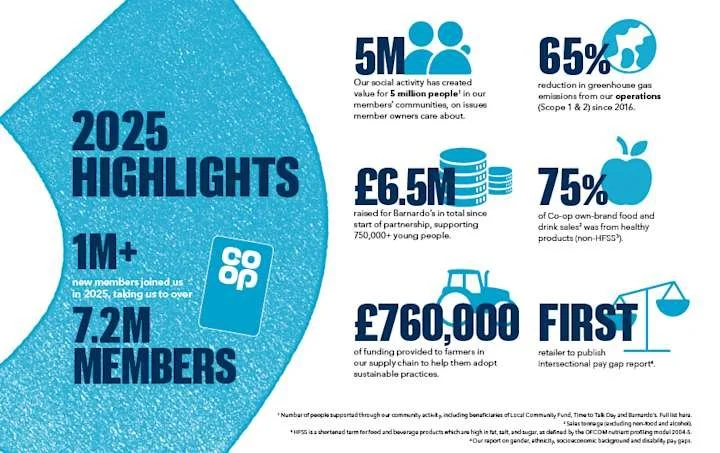
The Co-op's Community Fund works because members decide which causes get the money - youth groups, food banks, carers' networks. Things a central team could never accurately identify from head office. The brand doesn't decide what matters. The community does.
Source: Co-Op Sustainability Report 2025
The white space
Community isn't a soft add-on that sits underneath sustainability. It's a strategic asset - and right now, a largely unclaimed one.
Done properly, it builds trust, generates insight, and creates the kind of local presence no national campaign can replicate. Employees who believe their organisation has a purpose beyond profit are up to 40% more likely to stay (Deloitte, 2020). 59% of UK consumers choose, switch, or avoid brands based on company behaviour (Edelman, 2023). These aren't marginal numbers.
The businesses that treat community as a genuine strategic priority - grounded in local insight, aligned with what they can credibly deliver, given enough time to work - have a real advantage over those still treating it as a line item.
The jeaopardy? That white space won't stay open forever. Thankfully - that’s where we come in.
—
Interested? Talk to us at hello@connect2-uk.com or click the ‘contact’ button on the top right.